Godavari River
Highest number of dams among all river basins in India.

via Wikipedia: Godavari River Basin Irrigation Projects · see source
The Godavari River has its catchment area in seven states of India: Maharashtra, Telangana, Chhattisgarh, Madhya Pradesh, Andhra Pradesh, Karnataka and Odisha. The number of dams constructed in Godavari basin is the highest among all the river basins in India. Nearly 350 major and medium dams and barrages had been constructed in the river basin by the year 2012.
- annual_water_inflow
- Approximately 105 billion cubic metres
Lore & Background
The Godavari basin is home to an extensive network of dams and barrages, with nearly 350 major and medium structures built by 2012. Among these are the Jalaput, Chintalapudi lift, Uttarrandhra Sujala Sravanthi lift, Balimela Reservoir, Upper Kolab, Dummugudem Lift Irrigation Schemes, Nizam Sagar, Sriram Sagar or Pochampadu, Kakatiya Canal, SRSP Flood Flow Canal, Manjara Dam, Manjira Reservoir, Singur Dam, Shanigaram Reservoir, Lower Manair Dam, Mid Manair Dam, Upper Manair Dam, Yellampally, Taliperu Project, Babli barrage or Babhali, Devadula lift irrigation project, Polavaram Project, Inchampalli Project, and Sadarmat. Additional projects include the Alisagar lift irrigation scheme, Kaddam, Sri Komaram Bheem Project, Lower Tirna, Siddeshwar or Purna, Yeldari Dam, Godavari Canal, Mula Dam, Bhandardara Dam, Isapur Dam or Upper Penganga, Upper Dudhana Dam, Jayakwadi or Paithan, Upper Pravara, Upper Indravati dam, Upper Wain Ganga (Bheemgarh Dam), Upper Wardha Dam, Lower Wardha Dam, Majalgaon Dam, Ghatghar Dam, Upper Vaitarna Dam, Vishnupuri Barrage, Sirpur Dam or Bagh reservoir, Gosi kd Dam or Gosi Kund dam, Totladoh Dam, Kamthikhairy Dam or Pench dam, Erai Dam, Tultuli Dam, Arunawati Dam, Lower Wunna Dam or Wadgaon, Manar Dam, Lower Pus Dam, Ramtek Dam, and the Pench diversion Project in Madhya Pradesh.
Reader's Guide
The Godavari River basin is the most heavily dammed in India, with nearly 350 major and medium dams and barrages constructed by 2012. These structures serve irrigation, drinking water, and hydroelectric purposes across the seven states of the catchment area: Maharashtra, Telangana, Chhattisgarh, Madhya Pradesh, Andhra Pradesh, Karnataka, and Odisha. Key projects include the Jayakwadi or Paithan Dam, Sriram Sagar or Pochampadu, Polavaram Project, and Inchampalli Project. The Godavari Water Disputes Tribunal governs water allocation among the riparian states. For detailed information on irrigation projects in Maharashtra, refer to http://www.mahagovid.org/maha_dams.htm (archived 16 December 2004). For projects in Madhya Pradesh, see http://www.mp.nic.in/wrd/Comp_Works/SRLD/SRLD_index.asp. Additional resources include the Majalgaon dynamic regulation pilot project and the Godavari river water sharing accord.
Did You Know?
- The Godavari River has its catchment area in seven states of India: Maharashtra, Telangana, Chhattisgarh, Madhya Pradesh, Andhra Pradesh, Karnataka and Odisha.
- The number of dams constructed in Godavari basin is the highest among all the river basins in India.
- Nearly 350 major and medium dams and barrages had been constructed in the river basin by the year 2012.
Gallery
Frequently Asked Questions
What is the Godavari River?
The Godavari is a major Indian river that ranks as the country's second longest waterway after the Ganges. It is also the largest river in peninsular India when measured by length, drainage basin, and total water volume.
Where does the Godavari River originate?
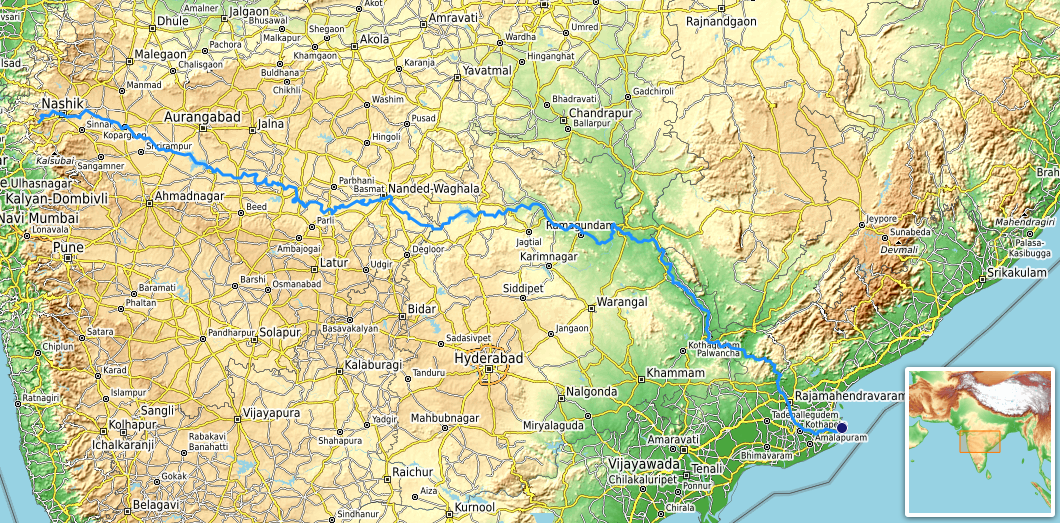
The river begins at Brahmagiri Mountain, roughly 5 kilometers from the town of Trimbakeshwar in Nashik, Maharashtra. From that source it travels eastward across the Indian subcontinent for its entire course.
How long is the Godavari River and where does it empty?
The Godavari covers 1,465 kilometers before discharging into the Bay of Bengal through a network of distributary channels. Its annual water inflow is approximately 105 billion cubic metres.
Why is the Godavari called the Dakshina Ganga?
The nickname 'Dakshina Ganga' (Southern Ganges) highlights its role as the preeminent river in southern and peninsular India. It parallels the Ganges in sheer scale and cultural weight, but serves the country's southern regions instead.
Why is the Godavari River important to India?
As the largest river in peninsular India by catchment area, length, and discharge, it sustains agriculture, hydroelectric generation, and millions of residents across several states. It drains the second largest river basin in the entire country, making it a critical water resource.
More in Rivers And Lakes 1-17
Spotted an error? Know more?
This is a living reference — every entry is fact-audited, and reader corrections feed straight into our audit queue. Suggest an edit · See this site's audit record